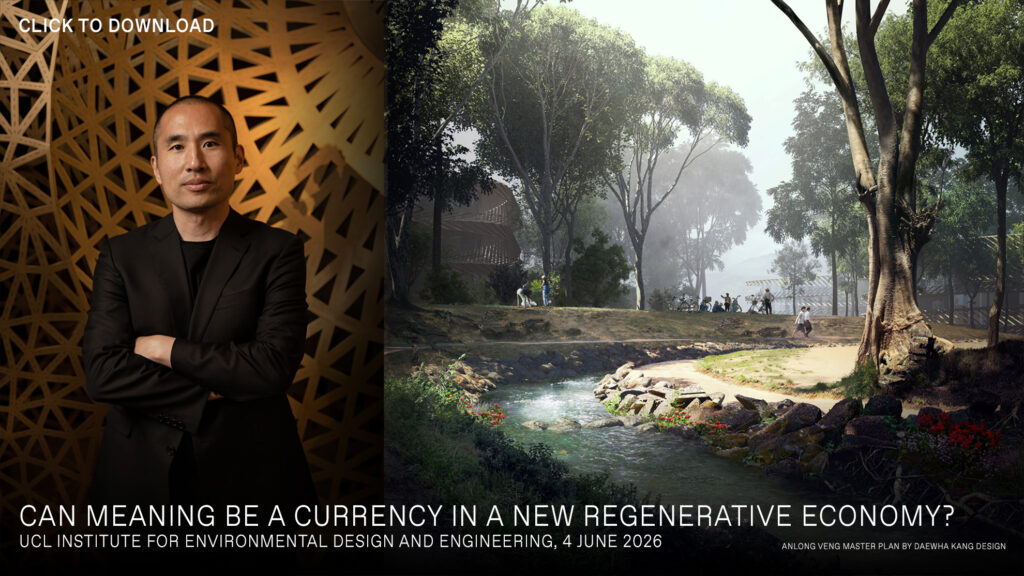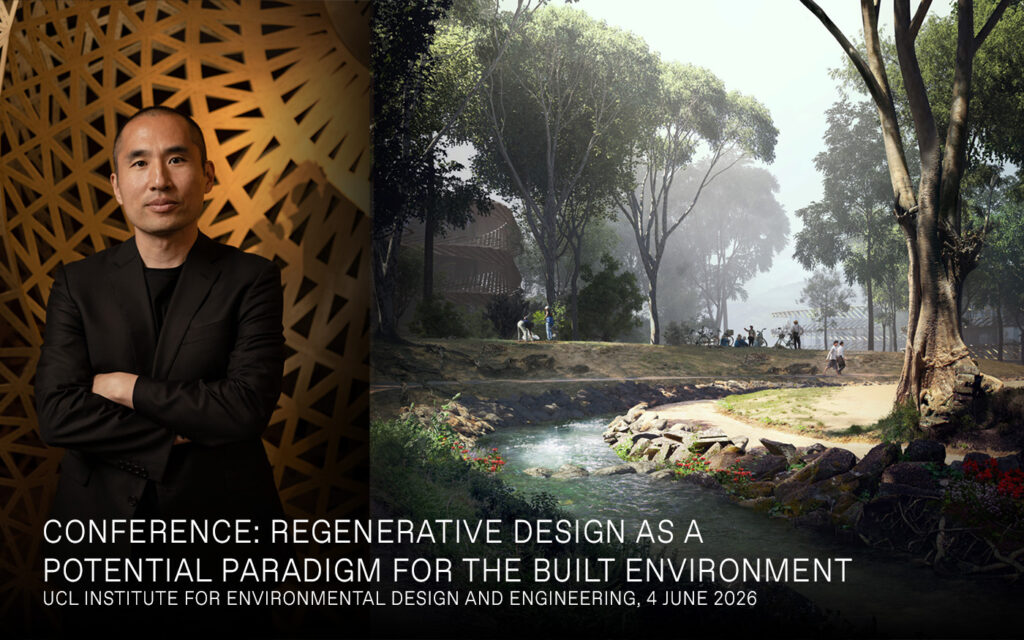
DaeWha was one of five expert panelists exploring how we define Regenerative Design at the University College of London Institute for Environmental Design and Engineering. "Can Meaning be a Currency in a New Regenerative Economy" presents the studio's work in the UK and Asia bringing together cultural development, heritage restoration, and ecological regeneration. The premise "Heal Landscape, Heal Society" is particularly important in today's climatic and geopolitical climate.
Download DaeWha's slides at the end of the article.
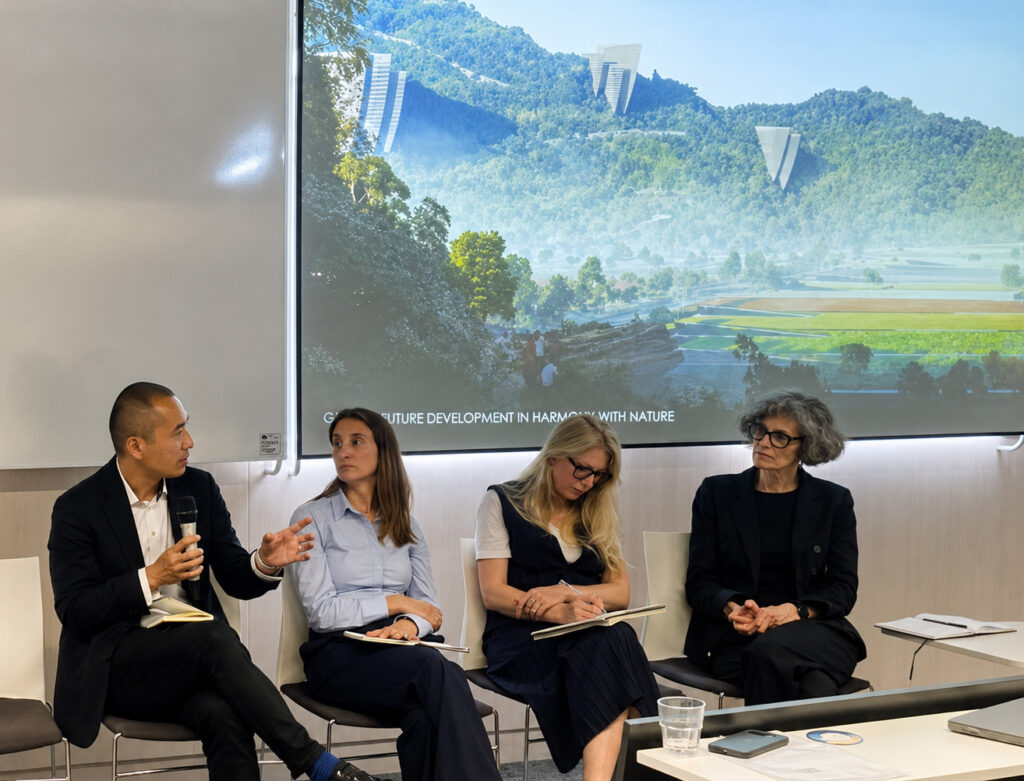
4 June 2026
Hello, I am DaeWha Kang.
For the last 11 years, our practice has been exploring the interrelation between nature, design and regeneration. From direct experience of nature, to the use of natural materials and forms, to permanent architecture that evokes geology or other natural phenomena, we are on a continuing search for new forms, new meanings and new ways to positively impact the world.
Among these accomplished colleagues, I come here as a designer and builder: building regeneratively, at all scales, on occupied sites. Others address regeneration through carbon, or through biology; for me it also includes the repair of meaning. So my argument today is that meaning can be a currency in the regenerative economy: and I will test that idea against three of our projects.
Our first use of the word “regeneration” came 10 years ago, as the title of our project: The Regeneration of St Andrew Holborn. Christopher Wren’s largest parish church was firebombed in World War II and rebuilt with a limited budget in the 1960s, and as we embarked on the task we searched for a word that would give us more direction and inspiration. “Regeneration” took us beyond a task of renovating or redesigning and brought us into the realm of a reimagining or rebirth.
There were basic things to be done. The architects in the 1960s ran out of money, unable to afford a stone floor. They used vinyl Marley tiles contaminated with asbestos. The colour scheme, lighting and decoration had taken on decades of clutter. None of Wren’s drawings remain, but we discovered through a deep dive into historic records a much more uplifting atmosphere: white and off-white colours, a stone floor. The work prioritised transformation over replacement, working with fewer resources and longer lifespan.
There was an opportunity to turn this cluttered chapel into a new baptistery. We discovered a spring under the church and were able to filter it, using the water for ceremonies. Roman artefacts were found near the spring, indicating that this may have been a spiritually significant site for more than 2000 years. An additional layer of history was the baptismal font installed in the 1960s when Thomas Coram’s Foundling Hospital was decommissioned. This particular font was used to baptise children who had been abandoned on the street, giving them new names and a new start to life. Clearing away layers of clutter revealed powerful moments of meaning.
Adding completely new layers of meaning is, to me, also a regenerative act. We developed this sculptural chapel with its reredos in brass, inspired by various themes: Maria Stella Maris, Mary star of the sea; St Andrew with his nets; and Christopher Wren’s interest in astronomy.
The Old War Office had a barren courtyard, the architecture designed to create an imposing imperial identity. We were asked to transform the space into a place of hospitality and welcome.
We introduced a new sculptural pavilion, fountain and paving design. Because the cobbles were original to Winston Churchill’s time as minister of war, they could not be removed. Historic England loved our organic designs for the pavilion and fountain and suggested, could we not develop a new pattern for the old stones? And this was the result: bringing fluidity, inspiration from nature, into a space that had originally been meant primarily for war.
Biophilic design cascades from the design of the fountain, to the architecture of the pavilion, to the interior of its columns and ceiling.
Finally, on the larger scale, we have worked at the border between Cambodia and Thailand, where from the late 1970s until the late 1990s the Khmer Rouge continued to fight a guerrilla war against the government and persisted in perpetrating acts of violence, both to people and to the landscape. This is a military contested area, the site of the current conflict with Thailand. It is also a beautiful natural ecosystem.
85% of the people here are ex-Khmer Rouge, who have slashed and burned the landscape due to their ideology of an agrarian-only economy. Due to the fighting and the persistent use of landmines, 25% of the population in this area is disabled.
Our client began a process of transforming sites of violence, such as Pol Pot’s house, transforming it into the Anlong Veng Peace Centre. We have fourteen sites, including a bridge and the lake that were made with forced labour, that could be turned into a worker’s vocational training centre; places of violence to women transformed into a women’s centre. Efforts of tree planting and reforestation are also underway.
A concept of Golden Thread works with the Ministry of Education and the Ministry of Tourism to create a regenerative heritage corridor. Visitors on this journey participate in reforesting and rewilding this linear path. The ultimate aim is for the linear reforestation project to form an armature for new urban development, capturing historical sites and protecting them, providing natural infrastructure for the new residents, all while using a minimum amount of developed land. What you see here is not old-growth forest but rewilding; it is not a natural stream but large-scale water infrastructure that can be used to manage climate-induced erosion and weather effects. You can see the initial principles for taking these sites of violence and marking or commemorating them through both design and through programme. Again we are adapting places, but in this case transforming their function or embodied meaning.
There is an idea, ultimately, that it would be possible to heal society and heal the landscape together.
We continue the search for projects at this intersection. With Jamie Miller from Atelier Ten in Canada, we have started preliminary conversations with First Nations groups there, where the government is investing in compensation and support for these people who have been in many ways marginalised. For cultures whose basic philosophy has always been to live in harmony with nature, design inspired by nature and finding meaning through nature’s forms may have a special resonance.
In the longest term, I would love to find a way to bring ecologically and culturally regenerative design approaches to the rebuilding of North Korea when it opens someday.
Thank you to Marcella Ucci for her support over the last 10 years, beginning with those biophilia projects in the Shard. I sit squarely at the practical and construction end of the architectural spectrum, but recognise that building beautifully is not enough. When my studio uses our phrase “beauty built with wisdom,” that aspect of wisdom that we aspire to needs a more rigorous and stronger framing.
Can meaning be a currency in a new regenerative economy?
For the past 10 years I have been writing open letters to the next generation, addressed to my unborn grandchild. When thinking about the significance of the Old War Office, or St Andrew’s, or Anlong Veng, I explore the ideas of embodied meaning in this regenerative architecture. My work is inspired by nature and its forms, but ultimately the celebration of meaning to human beings is what I find most beautiful.
I have often said that if we care about something we will care for it. If our world is suffering under the weight of disposable lifestyles and single-use everything, could a greater emphasis on meaning, on care, show us another path of healing? A path where we bring new life to existing places, where lighter touch, fewer resources, less waste and longer lifespan characterise our built environment? The next step for me is to understand how we measure these impacts, and ultimately scale them.
From sustainability to regeneration: Rethinking the built environment?
UCL Institute for Environmental Design and Engineering
04 June 2026
Kathryn Firth (UK Architects Declare)
Malina Dabrowska (Arup)
Dr Brenda Parker (UCL Biochemical Engineering)
Emily Loquidis (UCL IEDE)
DaeWha Kang (DaeWha Kang Design)
Yair Schwartz, Host (UCL IEDE)
Click image below to download the PDF.